«T’as voulu voir Vierzon et on a vu Vierzon»
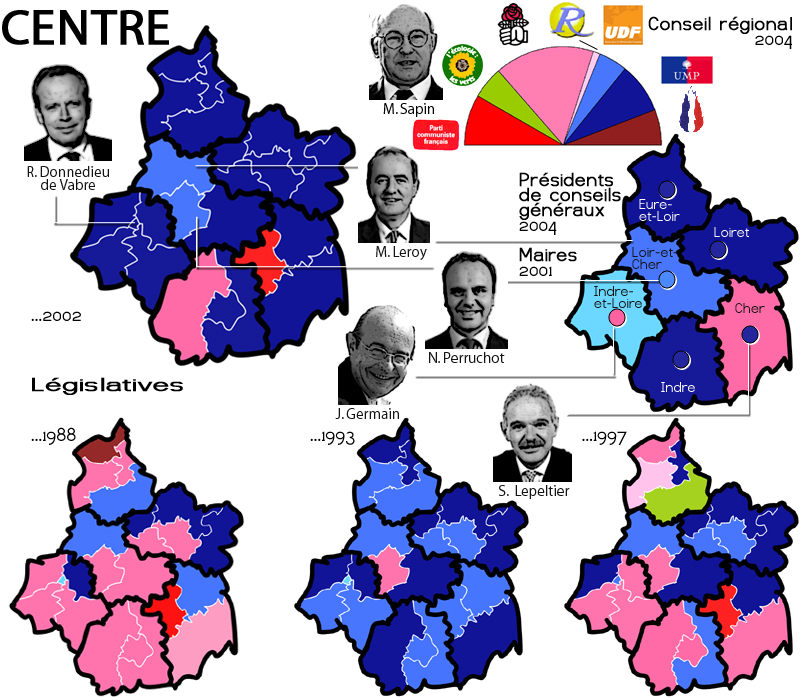
Aujourd’hui, c’est vendredi, et comme tous les jeudis, c’est élections. La région Centre, vaste, hétérogène a, c’est un comble, parfois été animée de tendances centrifuges, André Laignel («le nain sectaire», longtemps patron socialiste de l’Indre) demandant ainsi un temps le rattachement au Limousin. L’ouest (le Perche) regarde vers la Sarthe ou la Normandie.
Aussi, la région illustre certains traits socio-politiques repérables chez ses voisines, voire sur le territoire dans son ensemble:
- le conservatisme des paysans riches de la Beauce, jusqu’aux campagnes d’Orléans et Blois, et qu’on retrouve dans l’Essonne ou la Seine-et-Marne,
- par contraste, l’ancrage traditionnel à gauche des campagnes qui vont de la Ségolénie jusqu’à la Nièvre et au Limousin. Le Cher est même, avec l’Allier voisin, historiquement un des premiers et aujourd’hui derniers bastions du PCF: 75% de vote sur la motion Cachin dès le congrès de Tours, pacifisme dans des usines d’armement très syndiquées, détention par le Parti de la mairie de Bourges (et d’autres villes de moindre importance), depuis enlevée par Lepeltier, de 1977 à 1995. On notera la force, encore aujourd’hui, du PC dans la gauche régionale.
- le poids des choix urbanistiques. Ainsi, Tours est une ville modérée, de consensus, marquée par le règne sans partage et les choix d’aménagement judicieux de Jean Royer, également icône des petits commerçants et des anti-porno. Elle est passée au PS Jean Germain en 1995. RDDV en est le député mais n’a jamais réussi à conquérir la ville qui, paradoxalement, m’a semblé super-pédée (4 bars et un hôtel «à thème» pour 50 000 habitants). A l’inverse, Orléans ou Blois sont des villes éclatées, littéralement divisées, ou chaque bord politique joue un quartier contre l’autre, ce qui a fini par coûter ses places à Jack Lang, et amène l’alternance régulière à Orléans. A Dreux, cette même dissolution du lien urbain, couplée au fonctionnement comme sinistre hyper-banlieue de Paris, a permis l’apparition en avant-première du FN, avec feus les époux Stirbois.
Parmi les stars locales, on a aussi compté Michel «entonnoir» Debré (et briévement son fils Bernard, depuis parachuté à Paris 16e), maire d’Amboise (mais député de la Réunion). Merci de ne pas me rappeler que mon grand’père pense que Michel Sapin s’appelle Tannenbaum avec un geste significatif sur le nez. Chacun porte sa croix, si j’ose dire.
//
Today, it’s Friday, and like every Thursday, it’s election-day. The Centre region is large, heterogeneous. With an ironical twist, it was sometime busy with centrifugal trends: André Laignel (former Socialist boss of the département of Indre) once called for joining the Limousin region. The western part (le Perche) looks toward Sarthe and Normandy.
Thus, the region illustrates some socio-political traits relevant in its neighbours, or even the country as a whole:
- conservatism of richer peasants in the Beauce (north of the region), down to the countryside around Orleans and Blois, is also to be found in outer Essonne or Seine-et-Marne,
- in a contrasted fashion, the traditional left-leaning of country between Segolène’s Poitou, to Nièvre and Limousin. Cher (with neighbouring Allier) is even one of the historical strongholds and last retranchments of the Communist Party: 75% of votes for Cachin’s motion in Tours congress of 1920, pacifism in heavily unionised arms factories, a communist mayor in Bourges from 1977-1995, since outseated by Lepeltier. Also of interest if the PCF’s strengh within the region’s left.
- the weigh of urbanistic choices. Hence, Tours is a moderate, consensual city. It still bears the mark of the unshared power and judicious planning choices of Jean Royer, also an icon among shopkeepers and anti-porn campaigners. It’s had a Socialist townhall since 1995, with mayor Jean Germain. Renaud Donnedieu de Vabre is the local MP, but he has failed to be elected mayor, even though it seemed to me to be a hardcore-gay city (4 bars and a hotel for 50,000 inhabitants). Conversely, Orléans and Blois are fragmented, even divided cities. There, each political side plays a neighbourhood against another, which eventually costed its seat to Jack Lang and has caused many changeovers in Orléans. In Dreux, the same dissolution of social ties, and the functioning as a sinister hyper-suburb of Paris, allowed for the early rise of FN and the late Stirbois pair.
Among local stars was also Michel “wacko” Debré (and for a short time his son Bernard Debré, since then dispatched in the 16th arrondissement of Paris), the mayor of Amboise (but MP from La Réunion). Thanks for not mentionning that my grandfather thinks Michel Sapin’s true name is Tannenbaum, with a meaningful nose gesture. We all bear our cross, if I may say so.